Headspace Health is now Headspace, merging Ginger's clinical expertise with Headspace's meditations and mindfulness for comprehensive mental health care.
Blog Posts
 → 
How Qualtrics and Medtronic are making mental health support actually work
Workplace mental health

How Qualtrics and Medtronic are making mental health support actually work

BY 
The Headspace Team
Workplace mental health

How Qualtrics and Medtronic are making mental health support actually work

What’s a Rich Text element?

The rich text element allows you to create and format headings, paragraphs, blockquotes, images, and video all in one place instead of having to add and format them individually. Just double-click and easily create content.

Static and dynamic content editing

A rich text element can be used with static or dynamic content. For static content, just drop it into any page and begin editing. For dynamic content, add a rich text field to any collection and then connect a rich text element to that field in the settings panel. Voila!

How to customize formatting for each rich text

Headings, paragraphs, blockquotes, figures, images, and figure captions can all be styled after a class is added to the rich text element using the "When inside of" nested selector system.

At Conference Board San Diego, Lisa Mulrooney Gross, Chief People Officer at Headspace, joined Kristen Chan, Global Benefits Analyst, at Qualtrics and Jeanne Hermes, Benefits Consultant at Medtronic, to explore what's actually working, and what isn't, when it comes to employee mental health support.

Despite real progress in destigmatizing mental health, the numbers are still sobering:

  • Four in 10 employees have taken a mental health leave of absence. 
  • One in five regularly feel lonely at work. 
  • Over 80% of EAP-listed providers have wait times of 5–12 weeks for a first appointment.
  • Mental health challenges cost employers $47.6 billion annually and continue to drive healthcare claims.

The numbers tell the story. But the more important question is why — and what organizations are doing differently. Drawing on research and real-world experience, Lisa and her fellow panelists pointed to a clear shift: mental health is no longer a reactive benefit. It has to become an everyday part of how organizations support their people

Offering support is no longer enough. The gap between awareness and access is a core challenge for leaders.

Lisa opened the session by grounding the discussion in a reality many organizations are facing today. Awareness around mental health has improved significantly. Employees are more willing to talk about it, ask for support, and expect it from their employers. But willingness to seek help and actually getting it are two different things.

Some are unsure where to begin. Others face long wait times or confusing systems that make care feel out of reach. 34% of employees haven’t sought help simply because they don’t know where to begin.

The infrastructure hasn't kept up. More than 80% of in-network providers listed in EAP directories aren't actually available, and when employees do manage to reach someone, the wait for a first appointment is typically five to twelve weeks.

“It’s not just about offering support. It’s about making that support easy to access, understand, and use.”
— Lisa Mulrooney Gross, Chief People Officer, Headspace

This gap highlights a core challenge for leaders. Offering support is not enough. That support needs to feel simple, approachable, and easy to use.

The shift from reactive to everyday support

One of the clearest themes from the session was the move away from traditional, reactive models of care.

Historically, mental health benefits have been designed for moments of crisis. Employees access support when something feels urgent or overwhelming.

Today, that model is starting to change.

“Mental health can’t be treated as a point-in-time benefit. It needs to show up as an everyday capability.”
— Lisa Mulrooney Gross, Chief People Officer, Headspace

Lisa described a more modern approach where mental health support is:

  • Available every day
  • Flexible across different needs
  • Integrated into how people work and live

At Qualtrics and Medtronic, this shift shows up through broader care models that include self-guided tools, coaching, and clinical support.

“We’ve had to think about mental health as an ongoing support system, not just something employees use when they’re struggling.”
— Kristen Chan, Global Benefits Analyst, Qualtrics

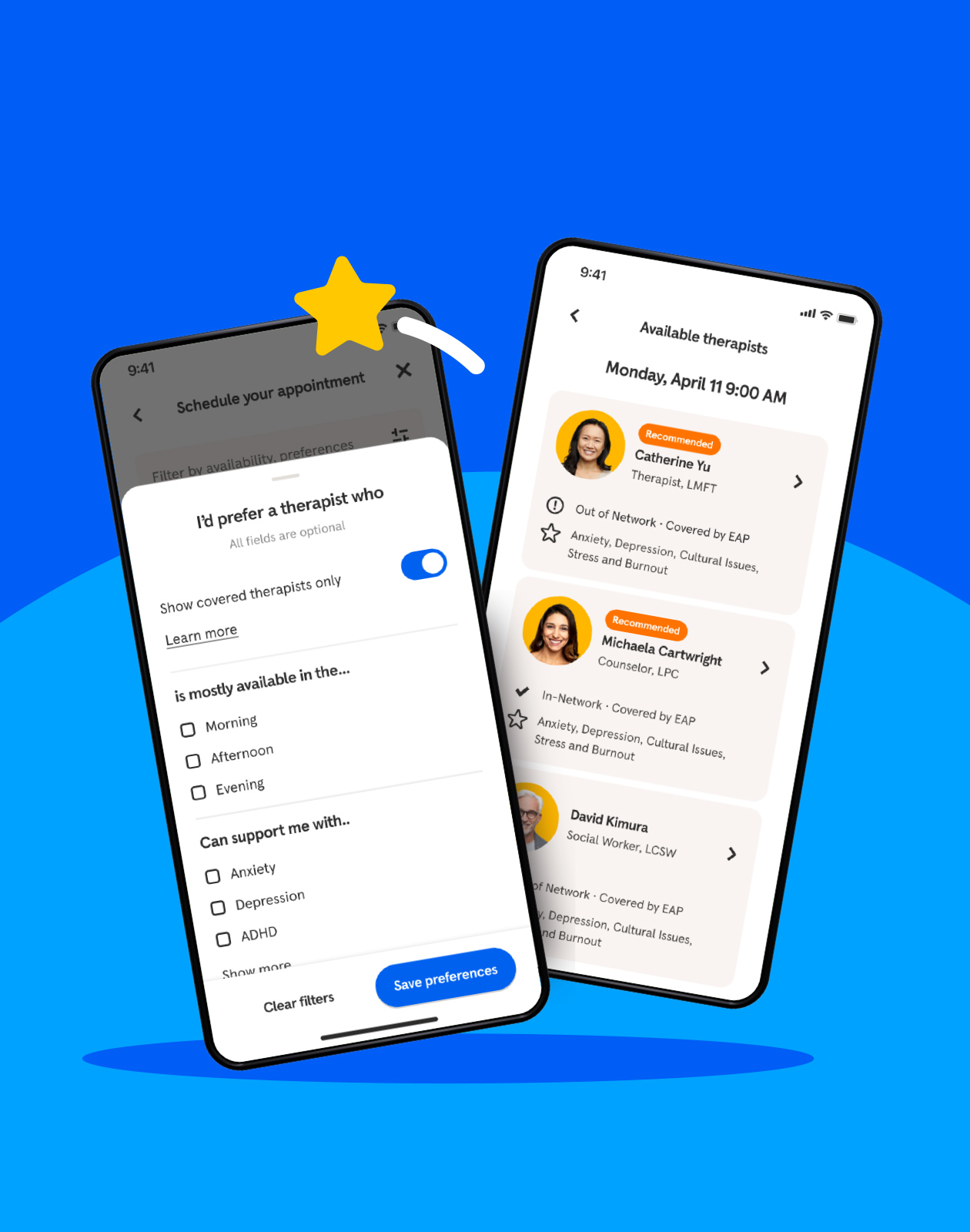
Employees can choose what feels right for them, rather than being directed to a single starting point.

Understanding what employees are navigating

At both Qualtrics and Medtronic, the shift away from this clinical-led support came from listening to what employees were actually struggling with — and it wasn't primarily clinical crises. It was "change whiplash." Constant organizational announcements, blended home and work demands, and generalized uncertainty that calls for everyday support — not a one-time referral.

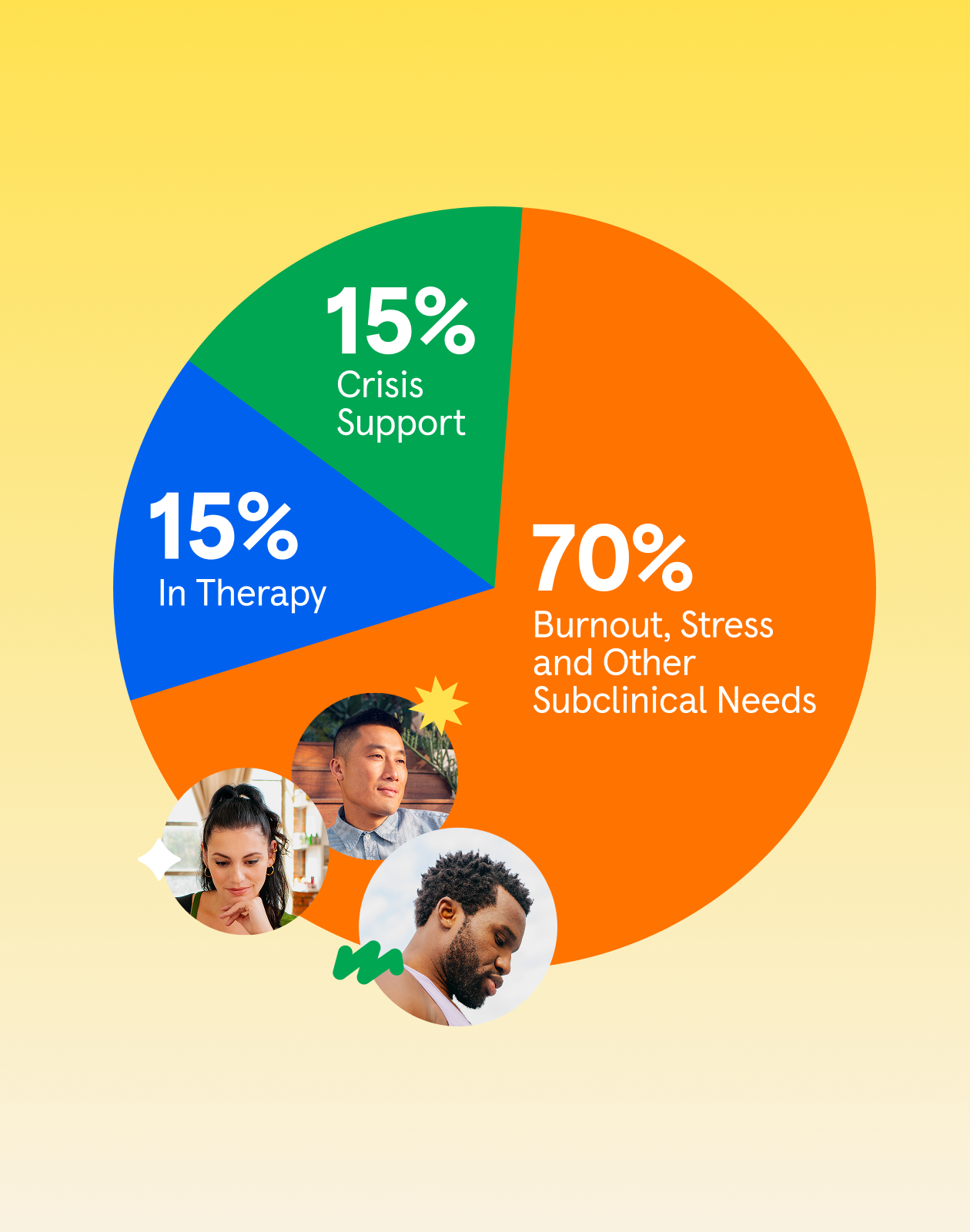
And the data supports this. Only about 1 in 100 employees needs specialty clinical care. But roughly 1 in 4 needs something — whether coaching, therapy, or guidance on a specific challenge. And the majority need everyday support: help with stress, sleep, focus, anxiety, or navigating caregiving responsibilities. 

Today, 60% of Gen Z and millennial employees expect their employer to play an active role in their wellbeing.

For many employees, stress is not tied to a single event. It shows up in small, everyday moments.

“We’re not living through change occasionally anymore. It’s constant, and that creates real fatigue for employees.”
— Kristen Chan, Global Benefits Analyst, Qualtrics

Lisa emphasized that support should fit into daily routines, not sit outside of them. That might mean taking a few minutes to reset between meetings, improving sleep, or accessing guidance in the moment a challenge arises.

Why traditional models fall short

The panel also explored why traditional approaches, including many EAPs, often struggle to drive engagement.

While designed to be accessible, these programs can feel:

  • Unclear at the point of entry
  • Intimidating, especially during stressful moments
  • Too focused on therapy as the first step

“It can feel intimidating to reach out when you don’t know who’s on the other side or what’s going to happen next.”
— Kristen Chan, Global Benefits Analyst, Qualtrics

Medtronic’s Jeanne Hermes added that even when support is available, the experience matters just as much as access. Jeanne raised a practical challenge that often gets overlooked: most mental health communications assume employees are sitting in front of a computer. For engineers on a production floor, field sales reps, or direct labor workers, that's simply not the reality.

Medtronic's solution was to partner with Headspace to create a postcard distributed to large US sites: a tangible card with a QR code to sign up for the app, plus two-minute exercises employees could do on the line or in a break room. The bigger principle: you have to reach people in the format and context that fits their work.

“We want to give people options and let them choose what feels right, instead of telling them what they need.”
— Jeanne Hermes, Benefits Consultant, Medtronic

When the first step feels too big, many employees choose not to take it at all.

Communication that employees actually read

As organizations rethink their approach, communication plays a critical role.

The panel shared several strategies that have helped increase engagement:

  1. Make mental health resources more visible and consistent
  2. Reduce communication fatigue through fewer, more intentional touchpoints
  3. Partner with employee groups to build trust and relevance
  4. Find ways to reach non-desk workers in accessible formats

“Less is more when it comes to communication. When it’s intentional, employees actually pay attention.”
— Kristen Chan, Global Benefits Analyst, Qualtrics

These efforts help normalize mental health as part of everyday work.

What outcomes look like in practice

Organizations that adopt this more integrated approach are already seeing results. Traditional EAP utilization typically hovers around 3–5%. 

At Qualtrics, 41.6% of the workforce has enrolled in Headspace and 58% have engaged in guided exercises or coaching. They've also seen positive movement in behavioral health spend year over year, a sign that earlier, lighter-touch support is moving the needle on cost too. Across Headspace programs, organizations have seen up to a 15% reduction in total healthcare costs among engaged members, reinforcing the impact of earlier, more accessible support.

“It’s not just about how many people use it. It’s about whether it actually helps when they need it.”
— Jeanne Hermes, Benefits Consultant, Medtronic

Employees are finding support in the moments that matter, which builds stronger, more resilient teams over time.

The question leaders should actually be asking

As the conversation wrapped, Lisa reframed the challenge for leaders.

Instead of asking how to improve mental health benefits, organizations should ask a different question.

“Is mental health a crisis benefit, or a core capability your workforce relies on every day?”
— Lisa Mulrooney Gross, Chief People Officer, Headspace

That shift reflects where the workplace is heading. Supporting mental health is not separate from business performance. It is part of how organizations help their people do their best work.

Continue the conversation

Most mental health benefits are built for the moment of crisis. The organizations seeing the best outcomes are providing support for everyone else too — the majority carrying everyday stress, burnout, and uncertainty. That's the shift Headspace was built to support. 

Connect with our team to explore what a whole-workforce approach could look like for your team.

The Headspace Team
Related articles
See all articles
Don't miss a thing
Subscribe to our blog for the latest insights from the team at Headspace.
By submitting this form, you agree that we may use the data you provide to contact you with information related to your request/submission and Headspace’s products and services. If you have already opted-in, you can control the messages you receive from Headspace in the subscription management center. You can unsubscribe from marketing email at any time by clicking the unsubscribe link in the email. Your data will be used subject to Headspace’s privacy policy.
  • template
Thank you! You are subscribed!
Oops! Something went wrong while submitting the form.